Merkle Mountain Range Multi Proofs
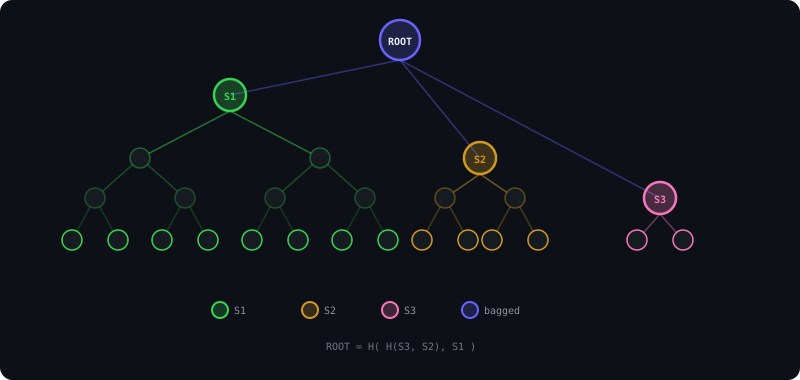
Merkle mountain ranges are an improvement over conventional merkle trees for growing, potentially unbounded lists. Where conventional merkle tree constructions over growing lists prove very inefficient to compute, as all nodes in the tree must be recomputed. Merkle mountain ranges amortise this cost by growing subtrees incrementally and merging subtrees at the same height, rather than growing the full tree.
Merkle mountain ranges, true to their name, are a type of merkle tree composed of perfectly balanced binary subtrees (each subtree has leaves for some ) arranged in decreasing height — forming a mountain range silhouette. This construction provides two key benefits over conventional merkle trees:
- Efficient appends. Inserting a leaf into a conventional merkle tree requires recomputing nodes (every node on the path from the new leaf to the root, plus the root changes position). In an MMR, appending a leaf is amortized — only the rightmost subtrees may need merging.
- Compact proofs over large sets. A proof for a single leaf requires at most nodes for the subtree proof (where is the subtree’s height) plus at most peak hashes for bagging — still total.
Capacity
An MMR where the tallest subtree has height can hold subtrees of every smaller height as well. When all heights from down to are present, the total leaf count is:
A conventional merkle tree of height holds exactly leaves. So an MMR with the same maximum proof depth holds nearly twice as many leaves:
| Height | Max leaves | Max proof size | |
|---|---|---|---|
| Merkle tree | |||
| MMR | (subtree + peaks) |
The MMR proof is at most twice as large, but this is a constant factor — both are .
MMR Multi Proofs
Our approach to verifying mmr multi proofs is to decompose the MMR into its constituent subtrees and verify each one independently using the position-based indexing model defined in my previous article.
An MMR with leaves decomposes into subtrees whose sizes are the powers of 2 in the binary representation of :
The number of subtrees (peaks) equals .
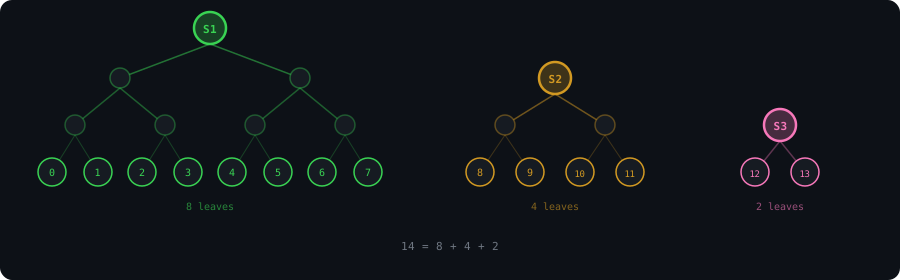
Each subtree is treated as a standalone merkle tree with 1-based position indexing. Within a subtree, leaf indices are converted to tree positions and siblings are paired bottom-up, consuming proof nodes as needed for missing siblings.
Proof Schema
The MMR proof uses a minimal format. The proof is a flat array of hashes, and each leaf carries its 0-based index across the entire MMR. Positions within subtrees are inferred from leafCount.
Verification Algorithm
The algorithm proceeds in three phases:
Phase 1: Decompose into subtrees. Walk through the binary representation of , peeling off the largest power-of-2 subtree at each step. Partition the leaves into each subtree by their index.
Phase 2: Compute subtree roots. For each subtree, convert leaf indices to 1-based tree positions and walk up level by level. At each level, check if the next node is a sibling (). If both siblings are known, hash them together; otherwise, consume a proof element as the missing sibling.
Phase 3: Bag the peaks. Combine the subtree roots right-to-left: .
Subtree Root Calculation
Each subtree is a perfect binary tree verified independently by converting leaf indices to tree positions and walking up:
Algorithm 1 Subtree Root Calculation
Require: leaves , proof hashes , position offset
Ensure: peak root hash
1:for all do
2:
3:end for
4:while do
5:
6:
7:while do
8:
9:if and then
10:
11:
12:else
13:if then
14:return
15:end if
16:
17:
18:
19:end if
20:end while
21:
22:end while
23:return
orders the hash inputs by position — even positions are left children, odd are right:
MMR Verification
With SubtreeRoot defined, we can now describe the full MMR verification:
Algorithm 2 MMR Multi Proof Verification
Require: proof hashes , leaves with 0-based indices, leaf count
Ensure: root hash of the MMR
1:if then
2:return
3:end if
4:if and and then
5:return
6:end if
7:if then
8:return
9:end if
10:
11:,
12:while do
13:
14:
15:
16:
17:
18:
19:if then
20:if then
21:break
22:end if
23:
24:else if and then
25:
26:else
27:
28:end if
29:end while
30:if then
31:return
32:end if
33:while do
34:,
35:
36:end while
37:return
Reference Implementation
A production Solidity implementation of this algorithm is available at polytope-labs/solidity-merkle-trees.
References
P. Todd. Merkle Mountain Ranges. GitHub, 2012. https://opentimestamps.org.